
New Outlier Culture Course
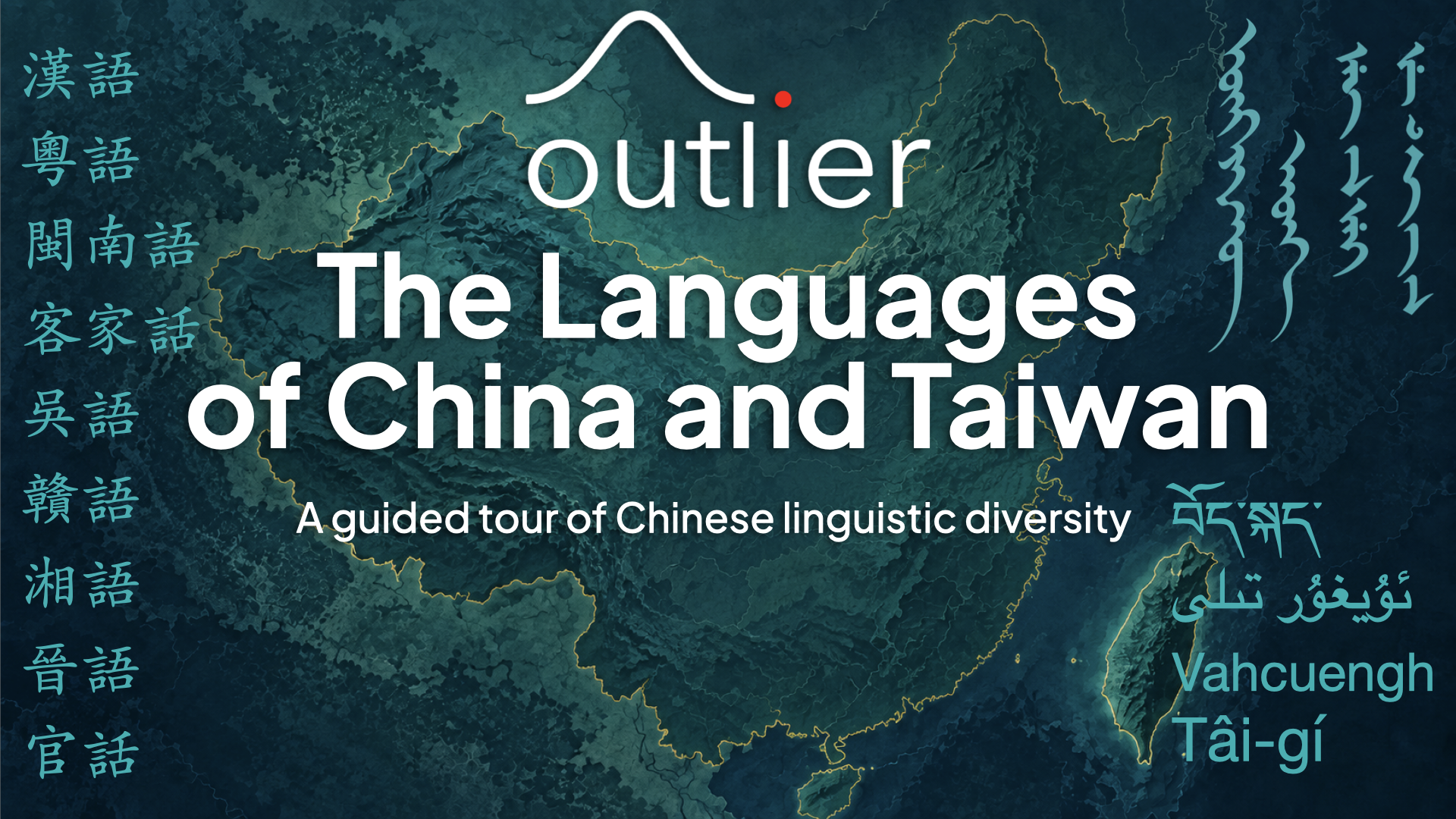
The Languages of China and Taiwan
Go beyond Mandarin and discover the remarkable linguistic diversity of China and Taiwan.
Chinese is not one uniform spoken language. Mandarin, Cantonese, Taiwanese, Hokkien, Shanghainese, Hakka, and many others are part of a much larger linguistic story. In this semester-length course, we’ll explore where these languages came from, how they relate to one another, and how they fit into the wider linguistic landscape of China and Taiwan.
Comprehensive Online Course, just $299 $199 through October 20th!
Outlier products are used and recommended at:

What it is
A guided tour through the remarkable linguistic diversity of the Chinese-speaking world
Most people who study Chinese encounter a fairly simple picture:
There’s Mandarin. There’s Cantonese.
Maybe you’ve also heard of Taiwanese, Hokkien, Shanghainese, or Hakka.
The real picture is far more interesting.
What we casually call “Chinese” includes a wide range of spoken varieties—many of them mutually unintelligible—with very different histories, sound systems, vocabularies, and regional identities.
And that’s only part of the story.
China and Taiwan are also home to languages from several entirely different families: Tibetan, Uyghur, Mongolian, Zhuang, Hmong-Mien languages, Austronesian languages, and many more.
In this semester-length Culture Course, we’ll build a coherent picture of how these languages fit together, where they came from, how they’ve influenced one another, and how language became intertwined with writing, migration, politics, regional identity, and culture.
“Chinese” is much bigger than most learners realize
A guided tour through the remarkable linguistic diversity of the Chinese-speaking world
If you’ve studied Chinese for any length of time, you’ve probably encountered some of these questions:
Is Cantonese a language or a dialect?
Is Taiwanese the same thing as Hokkien?
Why can two people both be speaking “Chinese” and still not understand each other?
Why does Cantonese preserve sounds that Mandarin lost?
Where does Shanghainese fit?
What exactly is a 方言?
How did Mandarin become the standard language in the first place?
And what about all the languages spoken in China that aren’t Chinese at all?
These questions are often treated as isolated bits of trivia.
They shouldn’t be.
Together, they tell the story of one of the most linguistically complex regions in the world.
This course will give you the framework to understand that story.
What this course is
The Languages of China and Taiwan is a 10-lesson survey of the linguistic history and diversity of China and Taiwan, with particular attention to the Sinitic languages.
We’ll look at the subject from three angles:
History
Where the Chinese languages came from, how they diverged, and how migration and contact shaped the linguistic map we see today.
Diversity
Mandarin, Cantonese, Min, Wu, Hakka, Gan, Xiang, Jin, Hui, Taiwanese, and the major non-Sinitic languages of China and Taiwan.
Practical language samples
Where possible, we’ll include short native-speaker sentence sets you can listen to and chorus—so you can actually learn a few phrases in Cantonese, Taiwanese, and other varieties covered in the course.
Language and society
Writing systems, standard languages, regional identity, language policy, language shift, and the forces that cause languages to spread, change, survive, or disappear.
This is not a technical linguistics course.
We’ll introduce linguistic concepts where they help explain what is happening, but the course is designed for serious learners and curious non-specialists.
By the end of the course, you’ll understand…
Why the simple division between “language” and “dialect” doesn’t work especially well in the Chinese context.
What linguists mean by Sinitic, and how the major Sinitic groups relate to one another.
How Mandarin became the basis of the modern standard language.
Why Cantonese differs so dramatically from Mandarin—and what older features it preserves.
Why Min is one of the most unusual and internally diverse branches of Sinitic.
How Taiwanese relates to Hokkien, Southern Min, and the broader history of migration from Fujian.
Why Taiwan is home to far more linguistic diversity than just Mandarin and Taiwanese.
How Chinese has interacted with Tibetan, Turkic, Mongolic, Kra-Dai, Hmong-Mien, Austroasiatic, Austronesian, and other languages.
How writing systems can unite communities that speak very different languages.
How education, migration, media, and government policy have reshaped the linguistic landscape of China and Taiwan.
Most importantly, you’ll come away with a coherent mental map of a subject that is usually encountered only in fragments.
Who is it for?
Mandarin learners who want to understand Chinese in a broader historical and linguistic context.
Cantonese or Taiwanese learners who want to see where their language fits into the larger picture.
People interested in Chinese history, writing, regional cultures, or linguistics.
Learners who know bits and pieces about 方言 but have never had a coherent framework for putting them together.
You do not need any prior background in linguistics.
And you do not need advanced Chinese.
If you’re curious about how the languages of China and Taiwan actually fit together, you’ll be able to follow the course.
A broad survey, with a few deeper dives
This course is designed to give you the big picture without treating every language as a name on a list.
That means we’ll occasionally slow down and look more closely at especially useful case studies.
Cantonese gives us a chance to explore a major regional language with its own strong media culture, written vernacular, and international presence.
Min lets us examine deep linguistic diversity, migration, literary and colloquial readings, and the connections between Fujian, Taiwan, and Southeast Asia.
Other languages and language groups will help us understand different aspects of contact, standardization, identity, and language change.
The goal is not encyclopedic coverage, but to leave you with a framework that makes the entire linguistic landscape easier to understand.
Curriculum
Lesson 1: What Is “Chinese”?
What exactly do we mean when we talk about “the Chinese language”?
We’ll look at terms such as 漢語 | 汉语, 中文, 國語 | 国语, 普通話 | 普通话, 華語 | 华语, 方言, “dialect,” “topolect,” and “Sinitic,” and examine why none of these maps perfectly onto the others.
We’ll also look at mutual intelligibility, writing, identity, and the difference between linguistic classification and cultural or political labels.
Lesson 2: Where the Chinese Languages Came From
Modern Chinese varieties are the result of centuries of divergence, migration, contact, and sound change.
We’ll look at Old Chinese, Middle Chinese, historical reconstruction, migration patterns, and the major changes that produced the modern Sinitic landscape.
Along the way, we’ll see why Cantonese, Min, Hakka, Wu, and Mandarin should not be thought of simply as regional variations of modern Standard Chinese.
Lesson 3: Mandarin and the Making of a Standard Language
“Mandarin” is itself a large and diverse group of speech varieties.
We’ll explore the historical meaning of 官話, the major Mandarin regions, the roles of Nanjing and Beijing, and the process by which a modern national standard was created.
We’ll also look at the relationship between 普通話, 國語, 華語, Beijing speech, and the many regional forms of Mandarin still spoken today.
Lesson 4: The Sinitic Family
A guided tour through the major Sinitic groups.
We’ll look at Mandarin, Yue, Min, Wu, Hakka, Gan, Xiang, Jin, Hui, and some of the problems linguists encounter when trying to classify them neatly.
You’ll hear representative examples, compare major linguistic features, and begin to see just how much diversity is hidden inside the word “Chinese.”
Lesson 5: Cantonese and the Yue World
Cantonese is one of the best-known non-Mandarin Sinitic languages, but Cantonese and Yue are not quite the same thing.
We’ll look at the broader Yue group, Guangzhou and Hong Kong Cantonese, written Cantonese, colloquial characters, media, migration, and the development of a strong regional and international linguistic identity.
We’ll also examine some of the historical features Cantonese preserves that Mandarin has lost.
Lesson 6: Min, Hokkien, and Taiwanese
Min is one of the most internally diverse branches of Sinitic.
We’ll explore Southern Min, Hokkien, Teochew, Fuzhou and other Min varieties, the importance of Fujian’s geography and migration history, and the spread of Min languages throughout Taiwan and Southeast Asia.
We’ll then look more closely at Taiwanese Hokkien, including its origins, writing traditions, literary and colloquial readings, and relationship to other Southern Min varieties.
Lesson 7: The Languages of Taiwan
Taiwan’s linguistic history extends far beyond Mandarin and Taiwanese.
We’ll look at Taiwan’s Indigenous Austronesian languages, Hakka, Taiwanese Hokkien, Japanese colonial influence, the arrival and spread of Mandarin after 1945, and the changing status of local languages.
We’ll also examine language shift, revitalization, bilingualism, and the ways Taiwan’s linguistic landscape has changed over the last several generations.
Lesson 8: Beyond Chinese: The Other Languages of China
China is home to far more than Sinitic languages.
In this lesson, we’ll survey the major non-Sinitic language families and communities, including Tibetan and related languages, Uyghur and other Turkic languages, Mongolian and other northern languages, Zhuang and other Kra-Dai languages, Hmong-Mien languages, Austroasiatic languages, and more.
We’ll also look at multilingual regions where centuries of contact have blurred the boundaries between language families.
Lesson 9: How China and Taiwan Write Their Languages
Chinese characters are only one part of the story.
We’ll look at the relationship between speech and writing in Chinese, vernacular Cantonese and Taiwanese writing, romanization systems, Zhuyin, Tibetan script, Mongolian script, Uyghur writing, minority-language orthographies, and the role of writing in standardization and identity.
We’ll also ask a broader question: how much of the idea of a unified “Chinese language” has been made possible by a shared written tradition?
Lesson 10: Language, Identity, and the Future
The linguistic map of China and Taiwan is still changing.
We’ll look at the spread of Standard Mandarin, regional language decline, bilingualism, intergenerational transmission, minority-language education, revitalization efforts, media, migration, and the pressures affecting local languages today.
We’ll finish by returning to the question we started with: After everything we’ve seen, what exactly is “Chinese”?
Ready to explore the linguistic diversity of Greater China?
See Chinese in a whole new way
Join The Languages of China and Taiwan and explore how Mandarin, Cantonese, Taiwanese, and the many other languages of the region developed, diverged, and shaped one another.
100% risk free - 30 day money back guarantee

Here's what you get:
10 weeks of guided lessons
Mandarin, Cantonese, Taiwanese, Min, Wu, Hakka, and more
Clear explanations of how the Sinitic languages developed and differ
The wider linguistic landscape of China and Taiwan: Austronesian, Turkic, Mongolic, and more
Writing systems, migration, language contact, and identity
A coherent framework for understanding what “Chinese” really means
Just $299 $199!
See why learners can’t get enough
These classical Chinese courses were right up my alley as I'm more interested in older Chinese culture vs. modern-day (and reading vs speaking), but incidentally force me to learn some modern Chinese along the way!
Peter W.
Margreet B.
Chris L.
I did learn to read some 古文 and 文言文 in the Taiwanese education system growing up. However, the method of teaching is purely chalk and talk. The teacher read the text, read out the translation in 白話 and we copy it down. The teacher would point out a sentence that is a 倒裝句 and the meaning of a peculiar or unusual vocabulary for us to memorise. That is the extent of teaching and learning of 古文/文言文 in my time. Consequently, I would have a hard time trying to understand a new 古文/文言文 text on my own for years until I took the Intro to CC course. Thank you John Renfroe and Ash Henson. I am very grateful for the courses as well as the teaching and expert knowledge provided.
Susan C. (native Mandarin speaker)
Meet Your Teacher
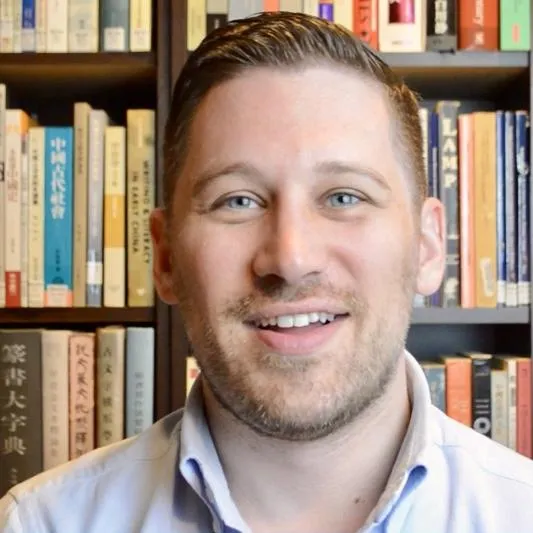
John Renfroe
Co-founder and CEO
Before co-founding Outlier, John studied Linguistics and Paleography in the Graduate Institute of Chinese at National Taiwan Normal University. He co-founded and later ran the Taipei Classical Chinese Reading Group, a weekly reading group consisting mostly of graduate Sinology students from western universities. He speaks some Cantonese and also studied dialectology 漢語方言學 in grad school. He also taught classical Chinese to members of the group who had no previous instruction in the language. His coursework and research focused on excavated Warring States bamboo texts, historical Chinese character morphology, and the Shuōwén Jiězì 說文解字 and its commentaries and criticism.
Frequently Asked Questions
Is this a language-learning course?
No. This is a Culture Course about the history, diversity, and sociolinguistics of the languages of China and Taiwan.
You will hear and examine examples from different languages, but the goal is understanding rather than learning to speak them.
Can I go at my own pace? Will I be able to access the course once I've finished it?
Yes! You get lifetime access, so we'll keep everything available online so that you can go through it at your own pace and review it whenever you want to!
How much Chinese do I need to know to take this course?
None.
Some knowledge of Chinese will make certain examples more meaningful, but the course is designed to be accessible without any knowledge of Chinese.
How long does the course take to complete?
There are 10 lessons, though we may add an 11th. We'll be releasing 1 lesson per week while the course is live, but you can go at whatever pace suits you!
How much time will it require per lesson?
That will depend on your level, but probably a few hours per lesson. The course is structured like a university course, so that should give you a guideline as to how much time you'll need.
Each lesson will contain about 30-60 minutes of video. You'll also get access to regular live "office hours" on Zoom, so you can pop in and ask questions if you'd like. There's also a discussion forum, so if you can't make it to the office hours, you can still get your questions answered.
Will I need anything (apps, etc.) in order to take the course?
Nope! We'll provide everything you need on the course platform.
What does "lifetime access" mean?
In practical terms, it means the course materials will be available online for as long as Outlier is in business. If we do ever go out of business or otherwise need to remove the course for any reason, we'll make the material available for you to download for a period of at least 6 months.
Why do you sometimes say “language,” “dialect,” “variety,” or “topolect”?
Because the terminology itself is part of the subject.
The English word dialect, the Chinese term 方言, linguistic classification, mutual intelligibility, and cultural identity do not always line up neatly.
We’ll deal with that question directly in the first lesson.
Can I get a refund if I decide the course isn't for me?
Yes! We have a 30-day, no questions asked refund policy. If you decide you don't like the course for whatever reason, just reach out by then and I'll be happy to give you a full refund. For those who sign up before the course goes live, the rule is "30 days from the start of the course."
Will there be other students at my level? Can we collaborate with other students or form study groups?
Definitely! There are always plenty of students at all levels in these "culture" courses. Most of them (including this one) are meant for people with any level of Chinese!
And sure, working together is no problem! You'll get access to a private online community where you can work together, ask questions, share notes, etc.
Copyright © 2026 Outlier Linguistics - All Rights Reserved